The 2026 hair accessories market will reward more than attractive colors and viral designs. Grand View Research’s 2024 Hair Accessories Market Size, Share & Trends Analysis Report forecasts continued market expansion, supported by online retail, personalization, and changing beauty routines. However, growth increases production pressure. A glossy headband can still hide weak stitching, sharp metal edges, unstable coatings, or excessive chemical odor.
This guide examines how to ensure quality control in hair accessory production through practical checkpoints. These include approved-material verification, supplier audits, first-sample approval, dimensional testing, pull-strength testing, surface inspection, and final packaging checks. SGS and Intertek testing guidance also emphasizes material safety, restricted-substance screening, and consistent product evaluation. Small details matter. A loose rhinestone may become a customer complaint. A brittle clip may fail after three uses.
Dr. W. Edwards Deming, a respected quality-management expert, stated, “Quality comes not from inspection, but from the improvement of the production process.” His principle remains useful for hair accessory factories. Inspection cannot repair careless sourcing or unstable machinery. Quality must begin with clear specifications and measurable controls. Even a detailed system can miss real-world problems. Humidity, transportation vibration, and repeated customer handling deserve more attention than many factories allow. The goal is not perfection on paper. It is dependable performance in a customer’s hands.
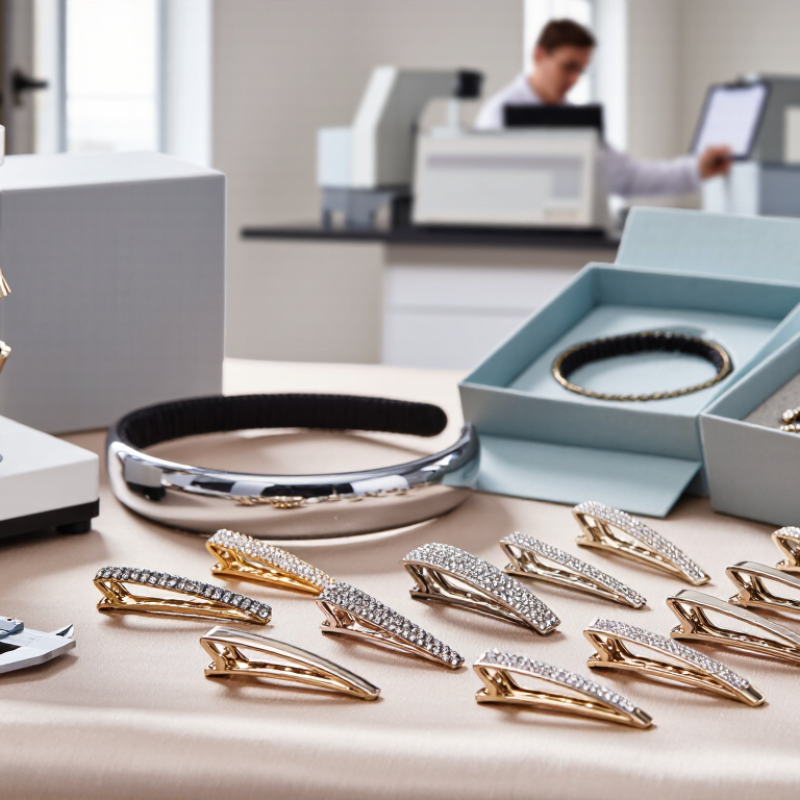
Defining quality standards for hair accessories in 2026 requires more than attractive design. Each item should meet measurable requirements for strength, comfort, finish, and material safety. Clips should open smoothly and hold hair without sudden slipping. Elastic bands need repeated-stretch testing, not only a successful first inspection. Edges must feel smooth against skin, while coatings should resist peeling after ordinary use.
A dependable quality process checks samples from every production batch. Inspectors can measure dimensions, test pulling force, examine color consistency, and simulate daily wear. Material records should identify suppliers and production dates. Clear traceability makes problems easier to isolate. It also supports responsible purchasing decisions. Still, no checklist catches everything. A decorative piece may pass laboratory testing but feel uncomfortable after two hours. Real-user feedback remains necessary, even when the results are inconvenient.
Tips: Create written acceptance limits for each accessory type. Photograph defects with a ruler beside the product. Test packaging for moisture and crushing damage. Review complaints monthly, then adjust the standard when patterns appear. A small sample may miss hidden variation, so larger checks are wiser for high-volume orders. Quality teams should document uncertain findings instead of forcing a quick approval. That honest pause can prevent repeated defects.
Stainless steel, cellulose acetate, nylon, and silicone can provide strength. Their safety depends on composition, finishing, and supplier controls. Appearance is not enough. A polished surface may still contain irritating residues or weak plating.
Suppliers should provide composition records, certificates, and batch-level traceability. Records should match the actual production lot. Colorants and coatings also need review. Missing documents create avoidable uncertainty.
Testing should screen for nickel release, lead, cadmium, phthalates, and restricted dyes. Sweat, saliva, heat, and friction can change surface behavior. Finished accessories need testing. Raw-material reports alone may not reflect the final product.
Test clips, elastic bands, and attachments for pull strength and fatigue. Children’s products need especially careful checks. Open and close clips repeatedly. Watch for sudden snapping, loose parts, and sharp edges.
No. Recycled content can reduce demand for new materials. It does not automatically confirm chemical safety. Suppliers should show contamination controls and colorant testing. Sustainability needs evidence, not just a recycled label.
Inspect incoming materials, assembly steps, and finished accessories. Measure headband width, fabric density, coating thickness, and spring tension. Check glue temperature, stitching strength, and attachment alignment. Look closely at fabric edges. Small details matter.
Use repeatable processes and clear material specifications before production. Record lot numbers and photograph defective units. Review complaints every month. Repeated opening cycles can reveal weak springs and loose attachments. Not every return comes from manufacturing.
No inspection is perfect. Human sampling can miss defects in mass production. A polished sample may hide inconsistent units. Use random retesting, layered checks, and honest failure records. Some problems remain easy to miss.
In 2026, quality control in hair accessory production begins with clearly defined standards for appearance, strength, safety, comfort, and performance. The process should use carefully selected materials that are non-toxic, durable, skin-friendly, and suitable for repeated use. Manufacturers should establish consistent production procedures, maintain accurate specifications, and conduct inspections at each stage to identify defects such as weak connections, sharp edges, uneven finishes, or poor elasticity. A reliable quality system should also include testing for comfort, functionality, durability, color stability, and resistance to everyday wear.
To understand how to ensure quality control in hair accessory production, businesses should combine product testing with supplier evaluation and complete recordkeeping. Packaging must protect products from damage, provide clear usage information, and support traceability. Supplier quality records, inspection reports, material certifications, and corrective action documents should be reviewed regularly. By integrating safe material selection, controlled manufacturing, performance testing, compliant packaging, and ongoing supplier monitoring, companies can deliver hair accessories that are consistent, comfortable, dependable, and suitable for consumer use.

 Galz Fashion